
We take safeguarding very seriously. The Academy has clear policies and procedures to safeguard and promote the welfare of young people.
If you have any safeguarding concerns and are unable to contact us in person or via telephone, please email: safeguarding@fwp.greenheartlearning.org
Out of hours:
The Children’s Advice and Support Service (CASS) provides a single point of contact for professionals and members of the public who want to access support or raise concerns about a child.
Monday to Thursday: 8:45am to 5:15pm
Friday: 8:45am to 4:15pm
Telephone: 0121 303 1888
Emergency out of hours telephone: 0121 675 4806
If a child is in immediate danger, please call 999.
Miss Byrne (Interim Headteacher)
Designated Safeguard Lead

Karen Kennedy
GLP Safeguarding Trustee
Deputy Designated Safeguard Leads
All adults who regularly work on our site are required to undergo a Disclosure and Barring Service (DBS) check to prevent unsuitable people from working with pupils. All visitors are closely supervised when on site.
We ensure staff have the skills, knowledge and understanding necessary to keep children safe through provision of regular training on child protection issues. A qualified Designated Safeguarding Lead within the Academy provides support to staff members to carry out their safeguarding duties and liaises closely with other services such as children’s social care. We also have a designated lead Governor for safeguarding/child protection on the Governing Body.
Our staff are trained to be vigilant for all kinds of safeguarding concerns, including bullying, online safety, emotional or other abuse or extremist behaviour. We have clear procedures in place where any potential safeguarding concerns are identified. We share information with other public bodies – within agreed protocols.
As part of the Academy’s safeguarding measures, we also ensure our pupils are not exposed to inappropriate political or controversial messages. Through our pursuit to develop exemplary citizens, we promote fundamental British values, including democracy, the rule of law, individual liberty and mutual respect and tolerance of different faiths and beliefs. In line with this, we ensure all expressed views and actions contrary to these values are challenged. We are alert to the indicators of radicalisation and take steps to protect those who may be susceptible to messages of violence. All concerns are reported and, where necessary, referred to external agencies.
Online Safety – Advice for Parents
Whilst our Academy has comprehensive safeguarding arrangements in place to ensure our pupils’ online safety, it is equally as important for parents to talk to their children about online safety and monitor their internet usage at home, using age-appropriate parental controls to restrict their access to unsavoury material. Parental controls can be activated on home broadband, search engines, YouTube, mobile phones and games consoles.
Whilst it may not always be easy to talk to your child about challenging issues such as cyberbullying, if you are open and honest with them about the dangers they may encounter online, it may encourage them to confide in you in the future. If you are concerned that your child is being secretive or spending too much time online, it may be worth moving their computer into a communal family area so that you can keep an eye on them.
You should encourage your child to act responsibility online, and treat others as they would wish to be treated. You should also warn your child that they should never hide behind an anonymous user name to make unkind comments, or say something they would be reluctant to repeat during face-to-face interactions. Remind your child that the comments they make and the pictures and videos they post online may end up having a wider audience than they anticipated – and even if they delete them, there’s no guarantee that someone hasn’t already saved, downloaded or taken a screen shot of their post.
Children under the age of 13 should not be using social networking sites like Facebook, Instagram and Tumblr – this is stipulated in the sites’ terms and conditions.
Parents should also be aware that content filters may not always work if a child is using public Wi-Fi, so it is important to ensure their access to unprotected Wi-Fi is limited.
Sharing nudes and semi nudes
This is now an issue in schools and we have a duty of care to inform you.
It may feel awkward, but it’s important to explain to children the risks of sharing nudes and semi nudes, how to stay safe and remind them that they can talk to you if something ever makes them feel scared or uncomfortable.
‘Sharing nudes and semi-nudes’ is the sending or posting of nude or semi-nude images, videos, or live streams by young people under the age of 18 online. This could be via social media, gaming platforms, chat apps or forums. It could also involve sharing between devices via services like Apple’s AirDrop which works offline.
The sharing of nudes and semi-nudes can happen publicly online, in 1:1 messaging or via group chats and closed social media accounts.
As of January 2016 in England and Wales, if a young person is found creating or sharing images, the police can choose to record that a crime has been committed but that taking formal action isn’t in the public interest.
Other forms of abuse that we always look out for in school are:
- Neglect
- Child sexual abuse
- Domestic abuse
- Online abuse
- Physical abuse
- Bullying and cyberbullying
- Emotional abuse
- Child sexual exploitation
- FGM
- Child trafficking.
There is a lot of information for parents on the NSPCC site: Keeping children safe online | NSPCC (external link). Please take time to have a look to make sure you are up to date with all the latest issues around safeguarding. Other useful websites include:
Childnet — Online safety for young people
Parent Zone | At the heart of digital family life
At Fairway Primary Academy, we prioritise the safety and well-being of our pupils while they use the internet. To ensure a secure online environment, we utilise LightSpeed as our filtering and monitoring system. This advanced technology helps us comply with the Department for Education (DfE) requirements by effectively blocking inappropriate content and monitoring online activity. LightSpeed enables us to provide a safe and supportive digital learning space, allowing our students to explore educational resources confidently and responsibly.
Our online safety lead in school is: Mr Irfan.
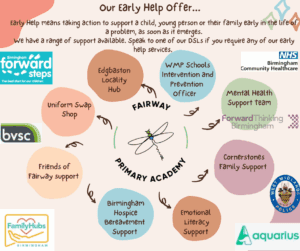
What is early help?
‘Early help’ describes any service that supports children and families as soon as problems emerge.
Examples of early help services include:
- Parenting support
- Play and activity groups
- Emotional health and wellbeing support
- Communication and language support
Many services will provide information and advice to support families. This can be offered in a one-to-one setting or as part of a group. They may also help families find solutions to specific problems.
Why is early help important?
Early help can prevent children from coming to harm. When families face problems, getting the right support, at the right time, is essential. It can be what stops a minor problem becoming a crisis.
Stepping in as soon as problems arise helps provide safe and happy childhoods. It helps keep families together. And it means children and young people are better prepared as they enter adulthood.
Here at Fairway, we are committed to supporting our families. If you require any support, or access to early help services, please call the school office and ask to speak to one of our DSLs.
You can find further information about the range of help which can be accessed through your local Early Help Locality Hub here:
Getting help for my family (Early Help) | I need help with… | Birmingham Children’s Trust
You can also download ‘From Birmingham with Love’ from our downloads section below. Here you can find support details for:
-Parenting
-Mental Health
-Finance
-Domestic abuse
-Problems with drugs or alcohol
-Bereavement support
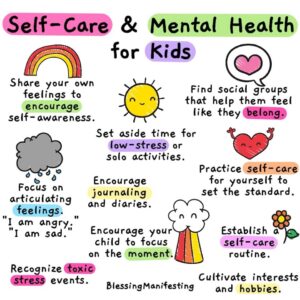
If you’re worried about your child or young person’s mental health or wellbeing, you can contact us directly in school or seek specialist advice from Young minds over the phone or online. Helpline advisers can provide information, advice and support to help you take the next step.
Parents Helpline | Mental Health Help for Your Child | YoungMinds
Remember, it’s okay to reach out for help. We all need a little extra support sometimes, and we hear from parents and carers just like you all the time.
Our Senior Mental Health Leads in school are: Mrs Addis and Mrs Ward.